THE HISTORY OF ESPRESSO — 1 of 4
The Espresso Coffee Machine
Historical Background
The origins of espresso: Turin, 1884. The first espresso coffees—called that even though espresso as we know it today is substantially different—were made in Turin in 1884, following Angelo Moriondo’s invention of a patented extraction machine.
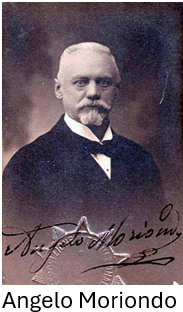
Angelo Moriondo
Angelo Moriondo’s family background and education. Angelo Moriondo (Turin, 6 June 1851 – Marentino, 31 May 1914) was an Italian inventor and entrepreneur, known for designing a machine for making coffee instantly. He came from a family of entrepreneurs: as early as the end of the eighteenth century, one of his ancestors had obtained a licence from the Savoy court to produce vermouth. His father, together with his brother Agostino and cousin Gariglio, founded the well-known chocolate factory “Moriondo & Gariglio”.
Between the ages of 14 and 18 (that is, from 1865 to 1869), young Angelo was sent to complete his secondary education at the boarding school of La Motte-Servolex, near Chambéry, the former capital of Savoy in France. He married Sinforosa Omegna, with whom he had four children: Giacomo, Caterina, Margherita and Antonio.
The business insight: from hospitality to “instant coffee”. Following in his father’s footsteps, Moriondo was deeply involved in successful hotel ventures. He expanded his business interests by buying the Grand-Hotel Ligure in Turin, in the centrally located Piazza Carlo Felice, and the American Bar in the Galleria Nazionale on Via Roma. It was precisely this hotel and restaurant business that gave rise to the need—and therefore the idea—to develop a machine for making “instant coffee”, so that he could quickly serve an increasingly demanding and hurried clientele.
The 1884 General Exhibition and the rebirth of Turin. Amid the extensive preparations for the 1884 General Exhibition at Valentino, Angelo Moriondo, driven by an ingenious entrepreneurial spirit, thought of modernising his establishments. It was an opportunity neither he nor his businesses could afford to miss, with hundreds of thousands of visitors expected in the city from across Italy and abroad.
At the time, Turin was experiencing a broad mood of renewal and major economic, political and social change. The Exhibition provided the occasion to set in motion a positive process that, after the disappointment of losing its political primacy when the Kingdom’s capital was moved, would definitively mark Turin’s transition from political to industrial capital, highlighting the great progress made in the half-century of liberal government. In short, the event was a chance to rouse the city from the lethargy into which it had fallen after the capital moved first to Florence (1865) and then to Rome (1871).
The Exhibition debut and the machine’s technical features. The machine was presented at the Turin General Exhibition at Moriondo’s stand, and the inventor received official recognition for the initiative. Built in collaboration with the mechanic Martina under Moriondo’s own direction, the apparatus was made of copper and bronze, stood about one metre high and had a distinctive “bell shape”, as reported in the Gazzetta Piemontese on 24 July 1884.
Steam pressure was around 1 to 1.5 atmospheres, corresponding to temperatures between 120 and 127 °C. Moriondo also had his machine installed at the General Exhibition in Valentino, inside a purpose-built kiosk where visitors could taste coffee made with the new invention.
Writing about this invention, a reporter described it in the Exhibition’s weekly newspaper as follows:
“A coffee maker worthy of serious consideration is the one displayed in a special kiosk near the entrance to the Electricity Gallery by its inventor, Mr Moriondo, proprietor of the Caffè Ligure, who operates it himself. It is a most curious displacement machine that makes three hundred cups of steam-brewed coffee an hour (actually with steam). It consists of a vertical cylinder or boiler holding 150 litres of water, which is brought to the boil by small gas flames beneath the cylinder; then, by means of steam and an extraordinarily intricate arrangement of mechanisms, ten cups of coffee can be made at once in a few minutes—or just one cup, if you wish.
It is the coffee maker taken to its highest stage of development, brought almost to the point of thinking for itself. And if Redi*, who railed against ‘bitter and vile coffee’, were to return to life and see how the world cares more about coffee than poetry, more about coffee makers than poets...”
Francesco Redi (Arezzo, 18 February 1626 – Pisa, 1 March 1697) was an Italian physician, naturalist and writer. He founded experimental biology and is nicknamed the “Father of Modern Parasitology”. Francesco Redi is considered one of the greatest biologists of all time.
The same reporter felt the need to return to Moriondo’s machine when later describing the Exhibition kiosks. He lingered over several notable for their grandeur, originality and beauty, designed by distinguished engineers and architects, before surveying “those that stand along the avenue between the front of the Electricity and War Gallery and the rear of the Fine Arts Palace”.
It was here that he pointed out the contrast between the modest structure and the ingenuity of the machine on display.
“Here stands Mr Moriondo’s modest kiosk, where one can admire the famous miraculous coffee maker, an invention of Moriondo himself, with which ten, twenty, a hundred cups of coffee are prepared in a few minutes.”
After submitting his application and supporting documents for a patent on 16 May 1884, Angelo Moriondo obtained registration under patent no. 33/256 of 16 May 1884, in these terms:
“Industrial patent certificate, for six years from 30 June 1884, issued to Mr Angelo Moriondo, in Turin, for an invention entitled: New steam appliances for the economical and instantaneous preparation of coffee as a beverage. – A. Moriondo System.”
On 20 November 1884, Moriondo submitted further documents to obtain additional patent protection for improvements made to his machine. Following this second application, registered as Vol. 34, no. 381, he obtained the following:
“Supplementary certificate to the industrial patent issued on 16 May 1884 – Vol. 33, no. 256, to Mr Angelo Moriondo, in Turin, for an invention entitled: New steam appliance for the economical and instantaneous preparation of coffee as a beverage, Moriondo system.”
For its time, Moriondo’s machine was truly revolutionary. It was an advanced apparatus, with a boiler equipped with all the controls (water level and steam pressure) and a safety valve. It was also extremely versatile, able to produce anything from one cup to many. What made it especially distinctive and innovative, however, was a filter-holder handle with a quick-release fastening: this feature made it, in every sense, the first espresso coffee machine. The inventor’s slogan is said to have been: “Come to the Ligure; we’ll give you coffee in a minute.”
Later, perhaps also following the success of the invention at the Turin Exhibition and the praise it received, Angelo Moriondo patented the machine abroad as well. In 1885, he obtained a French patent, issued in Paris on 23 October of that year.
Moriondo, however, did not exploit the patent industrially by starting mass production and large-scale sales, as one might have expected. This may be why his name is little known among historians of the field. Among coffee historians, the Australian Ian Bersten was the first to write about him.
His entrepreneurial activities drew him towards other goals: only a limited number of machines were built, and they were put to work mainly in his own public establishments, where they served to attract customers.
He had established the Società Anonima Stabilimenti del Ligure to manage the hotel and café, and, as a respected entrepreneur, joined the board of the Turin Chamber of Commerce. Nevertheless, Angelo Moriondo continued to take an interest in his espresso machine and, keeping pace with technological developments and changing tastes, later made further improvements to his original idea.
“The object of the present invention is a new coffee-making machine capable of producing, indifferently and instantaneously, from one to several cups of coffee or from one to several litres.”
On 30 December 1913, the inventor applied to extend the validity of this patent for another four years, receiving certificate no. 139663 on 8 April 1914. This last patent seems almost to assert his primacy in conceiving a true espresso coffee machine.
On 30 December 1913, the inventor applied to extend the validity of this patent for a further four years, obtaining certificate no. 139663 on 8 April 1914. This last patent seems almost to assert emphatically his chronological precedence in conceiving a true espresso coffee machine.
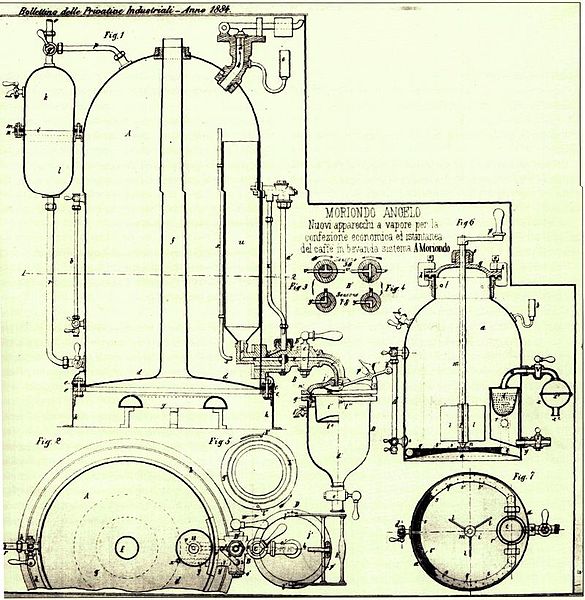

On 30 December 1913, the inventor applied to extend the validity of this patent for another four years, obtaining certificate no. 139663 on 8 April 1914. This last patent seems almost to assert his primacy in conceiving a true espresso coffee machine.
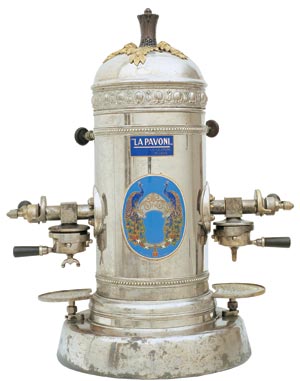
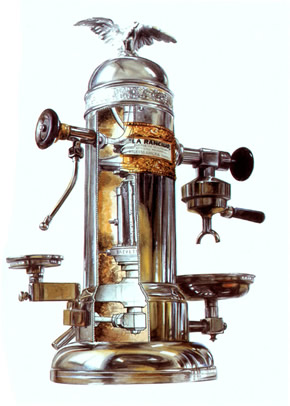
Beside the boiler were the dispensing groups, remarkably similar to those of today, where the portafilter containing ground coffee was attached. All one had to do was turn a tap, and boiling water, driven by steam at 120 °C and a pressure of barely one atmosphere, passed through the grounds. The result? A full minute’s wait—an eternity compared with the 25–30 seconds we are used to today. Moreover, the resulting coffee was a dark drink without crema, distinctly bitter and with a burnt aftertaste, much like coffee from an ordinary moka pot.
Next instalment: Achille Gaggia and the birth of modern espresso.
Leave a Reply