
Avventura Caffè · Part One
Imagine two rigid, sealed containers. The first holds only air. The second holds liquid water with only water vapour above it. We heat both from 20°C to 120°C. The volume inside each container stays the same. What do the two pressure gauges tell us?
Level 1 · What happens when we heat air and water?
First example · Air alone
Air molecules are constantly moving and hitting the walls of the container. As the air gets warmer, the molecules move faster and exert more force on the walls. The same amount of air, in the same space, produces a higher pressure.
Second example · Water and vapour
Some water evaporates even at room temperature. In a sealed container, the vapour stays inside, and some of it continually turns back into liquid. When water evaporates as fast as it condenses, the amount of vapour stabilises.
As we heat the container further, some more liquid becomes vapour. As long as both liquid water and vapour remain in equilibrium, each temperature has a corresponding pressure. A higher temperature means a higher equilibrium pressure.
Level 2 · What do the pressure gauges show?
A relative pressure gauge compares the pressure inside the container with the pressure outside it. If the two are equal, it reads zero. If the pressure outside is 1 bar and the pressure inside is 2, the gauge reads +1 bar.
At 20°C, the air in the first container starts at atmospheric pressure. In the second, we assume that the air has been removed and that some liquid water remains even at 120°C.
| Temperature | Gauge reading · Air only | Gauge reading · Water and vapour |
|---|---|---|
| 20 °C | 0.00 bar | −0.98 bar |
| 100 °C | +0.27 bar | about 0 bar |
| 120 °C | +0.34 bar | +0.99 bar |
Values are rounded and assume an atmospheric pressure of 1 bar. Negative readings require a gauge that can measure below atmospheric pressure.
Why does the water container start with a negative reading? At 20°C, water vapour alone exerts much less pressure than the surrounding atmosphere. If we sealed the container with room air still inside, the air would contribute to the total pressure alongside the water vapour.
Why is there still liquid water at 120°C? In an open pan, water boils at around 100°C under ordinary atmospheric pressure. Inside a sealed container, the pressure can rise. At 120 °C, liquid water and vapour can coexist at about 2 bar absolute. With 1 bar outside, the gauge reads about +1 bar.
Level 3 · The two relationships between temperature and pressure
Air alone · Heating at constant volume
A process at constant volume is called isochoric. Under the conditions in our example, we can describe air using the ideal gas law:
PV = nRT
P is absolute pressure, V is volume, n is the amount of gas in moles, R is the gas constant and T is temperature in kelvin. Because the container is rigid and sealed, both V and n stay constant. So:
P₂ / P₁ = T₂ / T₁
From 20°C to 120°C we go from 293.15 K to 393.15 K. The absolute pressure increases by a factor of 393.15/293.15, or about 1,34. Starting at 1.00 bar absolute, we reach 1.34 bar absolute. Subtract 1 bar of atmospheric pressure to get +0.34 bar on the gauge.
Water and vapour · The saturation curve
The second container also has a fixed total volume . The total mass of water stays the same, while the proportions of liquid and vapour can change. Some of the energy supplied during heating drives this change of phase. The energy needed to vaporise a given mass of water at its saturation temperature can be calculated from its latent heat of vaporisation.
As long as liquid and vapour coexist in equilibrium, the pressure follows water’s saturation curve. The curve gets steeper as temperature rises. Between 100°C and 120°C, the saturation pressure increases by about 0.97 bar, while the pressure in the air-only container rises by about 0.07 bar. If all the liquid evaporated, we would have to calculate the pressure from the state of the vapour alone.
A third case · A pipe completely filled with water
Imagine a section of pipe filled with water and sealed at both ends. As the water heats up, it tends to expand. If the pipe barely flexes and the water has nowhere to go, even a small amount of prevented expansion can cause a large pressure rise because water is difficult to compress. The actual rise also depends on how much the pipe and its connected components can deform. We’ll come back to this when we look at the expansion valve.
Next time · The espresso machine boiler and its four valves
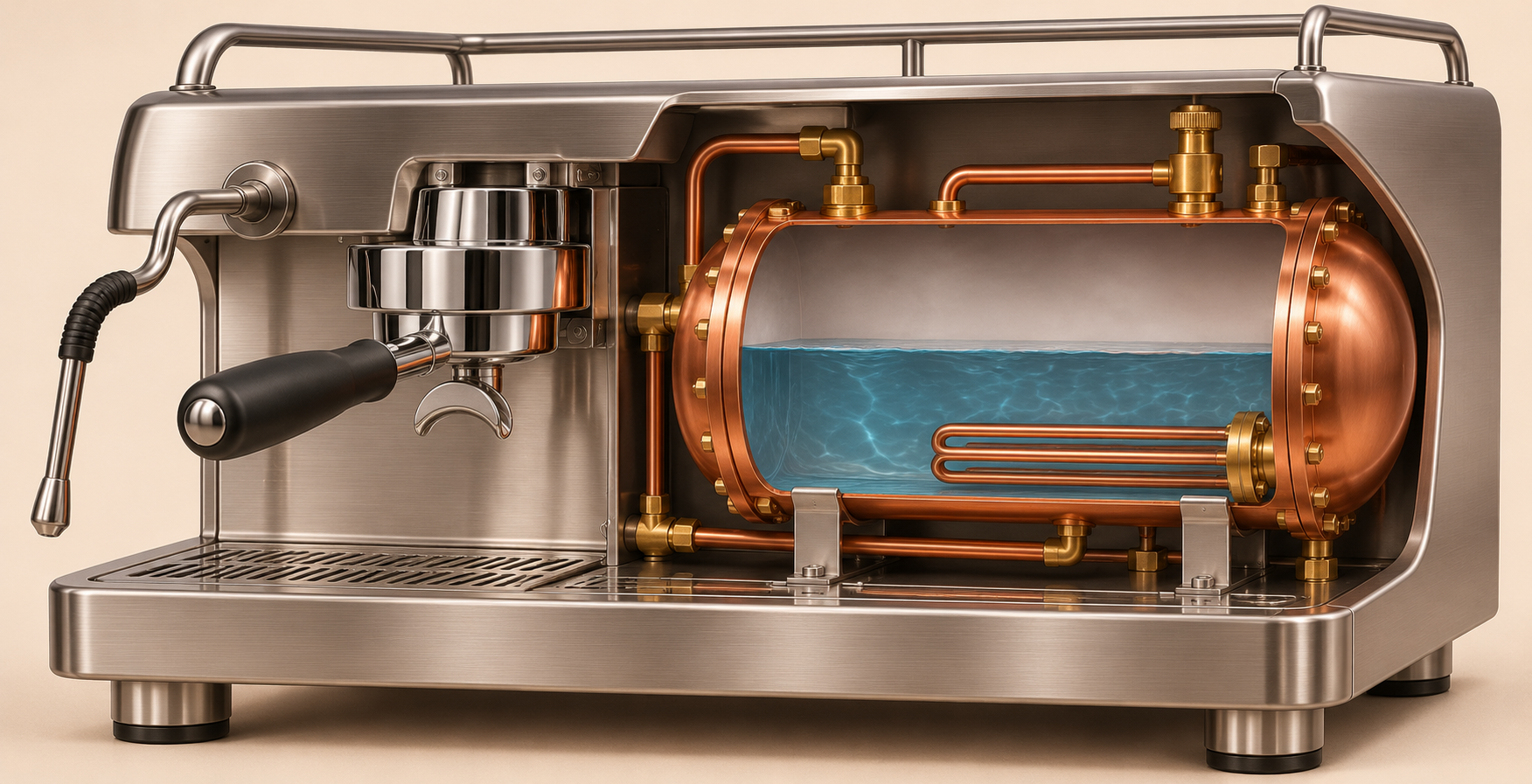
The two containers help explain how an espresso machine boiler works and why the machine uses four different valves. The relationship between temperature and pressure helps us interpret the boiler gauge. The presence of air and the expansion of water help explain what happens during warm-up in both the boiler and the water circuit.
In the next instalment, we’ll follow these changes on a diagram of the machine. We’ll see how the boiler produces steam and revisit the four valves already covered on Avventura Caffè.
- Vacuum breaker · Lets air escape from the boiler during warm-up.
- Safety valve · Protects the boiler against excessive pressure.
- Check valve · Prevents water from flowing backwards through the circuit.
- Expansion valve · Limits the rise in pressure when trapped water heats up in a closed section of the circuit.
Sources
- OpenStax, University Physics · The relationship between temperature and pressure for a gas at constant volume. Molecular Model of an Ideal Gas
- Saturated water property tables · Equilibrium pressures for liquid water and vapour. Table A.2
- La Marzocco · Steam boiler warm-up and operation of the expansion valve. One-group machine manual
Leave a Reply