
Technological innovation
The insight behind the lever system makes it possible to lower the water temperature: from over 100 °C to around 90–92 °C. The result is decisive: coffee loses the intensely bitter, burnt note that characterised earlier extraction methods, becoming more balanced and pleasant.
The pressure of 9–10 atmospheres (now more commonly measured in bar: 1 atmosphere equals 1.01325 bar), at which the piston pushes the water, creates an emulsion — the mixing of liquids that do not normally combine evenly — and enables the formation of crema, the true hallmark of this most Italian of beverages.
The lever machine, through its successive developments, remains the only viable system until 1956, when La Cimbali patents the hydraulic group, followed in 1958 by the thermocompensated group. The major technological leap comes in 1961, however, when Faema introduces an electrically driven volumetric pump: the celebrated E-61 is born. The letter “E” refers to the total eclipse of 15 February that year, a detail that adds to the appeal of a machine destined to define an era.
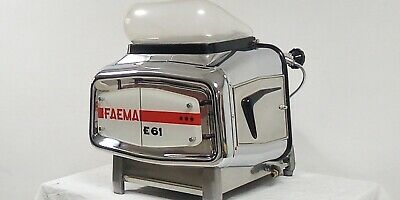
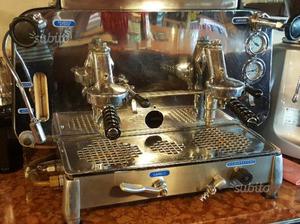
The Faema E61 introduced a series of technological solutions that marked a turning point in the history of espresso. For the first time, the pressure required for brewing was generated by electricity rather than manually through a lever: an electrically driven volumetric pump provided a constant, controlled flow, making extraction more stable and repeatable.
Another fundamental innovation was the heat exchanger, which enabled an efficient hydraulic system and helped stabilise the machine’s temperature. Thanks to the continuous circulation of water through the brewing group, the machine maintained a more balanced thermal environment, an essential condition for producing quality espresso.
The E61 also introduced the concept of hydraulic pre-infusion, drawing on experience gained with lever machines. At the start of brewing, hot water reaches the coffee puck at a lower, modulated pressure, thanks to dedicated chambers and flow restrictors. This initial phase allows the ground coffee to become evenly saturated, improving extraction and making the espresso richer, creamier and more aromatic.
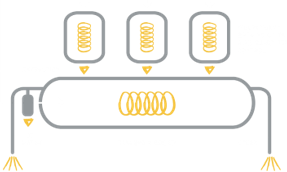
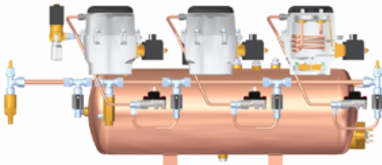
The 1970s brought a further development: machines with separate boilers, one for steam and another for the water used to brew coffee. This solution increased thermal stability and offered greater flexibility in temperature management, allowing extraction to be adapted to different blends and the sensory characteristics of espresso to be adjusted. It was a decisive step forward in the pursuit of technical and sensory perfection.
Superautomatic machines
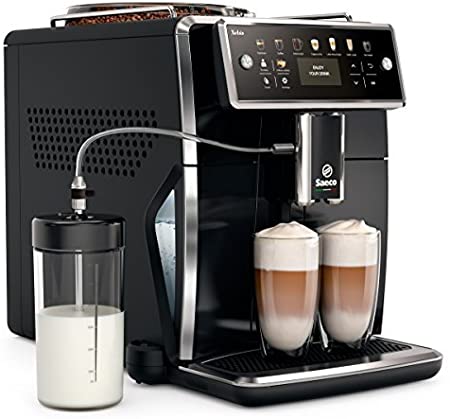
Superautomatic machines appeared in the 1980s: appliances capable of managing the entire coffee preparation process. Equipped with one or more built-in grinders, they eliminate the need for a portafilter and fully automate grinding, dosing, tamping and brewing.
Today, technology plays an increasingly central role in the development of coffee machines. High levels of automation and considerable flexibility in thermal regulation allow the final drink to be highly customised to suit consumers’ preferences. This growing sophistication, however, requires specialised technical knowledge and understanding to manage such complex machines correctly.
It should nevertheless be emphasised that, with superautomatic machines, achieving an authentic Italian espresso — understood as the fullest expression of the sensory characteristics specified by the protocol — is not always straightforward. Espresso is a delicate beverage: once extracted, it must reach the cup immediately, otherwise it deteriorates rapidly.
In superautomatic machines, the path taken by the coffee from the point of extraction to the cup is often too long and includes changes in the diameter of the conduits. This can cause:
- premature deterioration of the crema,
- possible contamination of the beverage,
- loss of temperature,
- less-than-optimal flow,
- pressure that is not always constant.
For these reasons, superautomatic machines are better suited to coffees with characteristics different from those of traditional Italian espresso. They are widely used in hotels and in northern European markets, where longer, less concentrated drinks are preferred.
Leave a Reply