
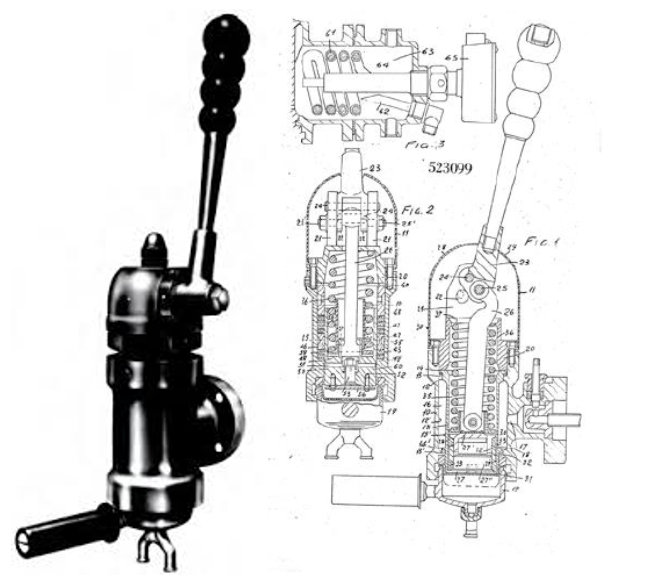
The customers’ initial hesitation was understandable: Achille Gaggia was proposing a completely new way of enjoying coffee. The drink produced by his machine had a rich aroma, a full flavour and, above all, a hazelnut-coloured crema unlike anything they had seen before. It was natural to wonder whether that texture was the result of a clever trick or whether this really was coffee. Before long, however, experience dispelled their doubts.
.Within a few months, the new system had been adopted by some of Milan’s most renowned cafés, including Motta and Biffi, in the prestigious Galleria Vittorio Emanuele. The response was immediate: crowds flocked to try it, forming queues so long that the police were even called in to manage the influx. Milan lined up to taste Gaggia’s natural coffee crema, turning the innovation into a city-wide phenomenon.
Despite this overwhelming success, Gaggia did not yet have a workshop capable of manufacturing machines in series. The decisive step came when he met the entrepreneur Carlo Ernesto Valente, who made his company available to begin producing espresso machines. Their collaboration led to the creation of “Officine Faema brevetti Gaggia”.
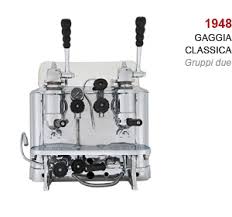
Classica (1948). This productive partnership gave rise to the “Classica” in 1948, a machine that marked an important step forward in technology, through the introduction of the lever, as well as in functionality and appearance. The Classica was among the first machines to feature a horizontal layout, which made it more practical: several groups could be arranged side by side, giving the barista easier access and allowing high output. It also had a cup-warming shelf that used heat from the heating system to keep cups at the right temperature.
The success of the Classica was driven by the remarkable quality of the coffee it produced, with more crema and aroma than before. Alongside the early machines came the famous logo that would accompany the Gaggia brand from then on: a traditional-looking coffee pot next to a modern lever group.
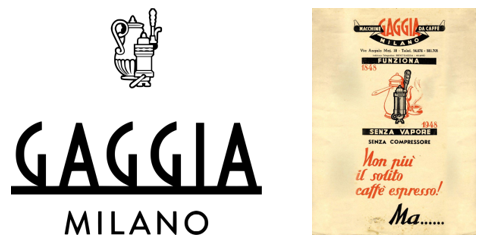
The Gaggia logo immediately conveys the combination of tradition and change. The juxtaposition of a traditional coffee pot and an innovative piston is no coincidence: the logo expresses the principle that has guided the company from the beginning, a tradition continually evolving. It also reflects Giovanni Achille Gaggia’s keen understanding of communication. Well ahead of his time, he recognised the importance of promotion built around clear messages and evocative graphic symbols.
Gaggia organised direct sales to cafés: during the night, the old vertical, cylindrical machines, now outdated, were removed and replaced with new, wide, horizontal models. Step by step, this gradual change helped transform the history of espresso.
In 1950, the collaboration between Achille Gaggia and Carlo Ernesto Valente came to an end. Having developed different commercial visions, the two entrepreneurs decided to part ways. For Achille Gaggia, a new phase of production began, this time in an equal partnership with engineer Armando Migliorini. At the Milan premises at Via Archimede 69, later moved to Via Cadolini 9, coffee-machine production expanded rapidly.
Meanwhile, the daily coffee ritual, so deeply rooted in Italian life and beyond, attracted increasing numbers of customers to cafés. Growing demand, together with the desire to experiment that characterised this particularly creative period, encouraged entrepreneurs to turn to architects and designers to develop products better suited to new needs. In this context, the industry moved towards large-scale production and design that combined functionality, aesthetics and innovation.
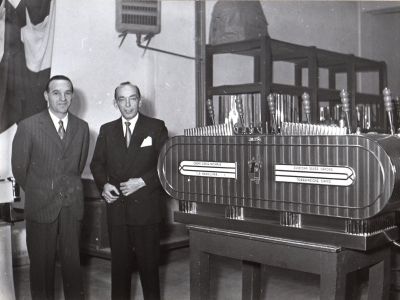
After the Classica, Gaggia began producing several highly successful café models with a striking appearance. The new machines featured gold-coloured finishes and illuminated chrome panels, designed to highlight the elegance of equipment destined for carefully furnished, prestigious public spaces. The earliest models were influenced, at least in part, by American Streamline styling. The Gaggia Esportazione 1950 is a notable example.
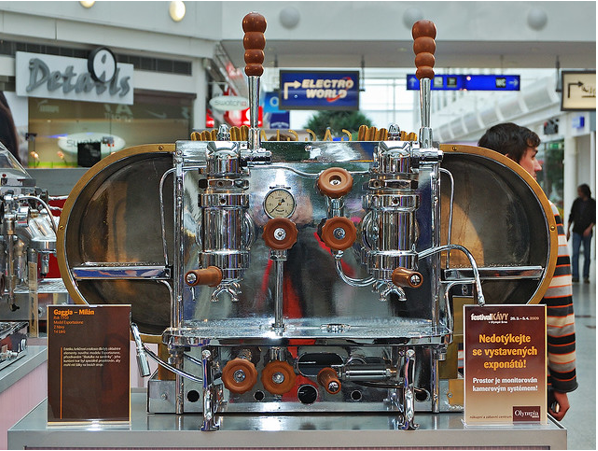
Gaggia Esportazione 1950. By 1952, the success of Officine Gaggia was firmly established: the factory was operating at full capacity and producing a wide range of equipment, from grinder-dosers to machines with multiple groups. By the mid-1950s, lever machines were widespread across almost all of Italy, and espresso was becoming increasingly popular. The sector included numerous businesses, with almost fifty registered companies. In this setting, Gaggia began to expand its sales abroad.
In 1952, the first Gaggia machine, a Classica, arrived at the Moka Bar in London’s Soho district, and shortly afterwards at Bar Italia, bringing with it the novelty of coffee crema. It was an immediate success and spread rapidly through the capital’s creative scene, long a centre of new trends and alternative tastes. Gaggia thus became the first Italian brand imported into the United Kingdom.
Within a few years, espresso had become a rapidly growing trend beyond Italy’s borders, as had cappuccino, closely associated with the idea of Italian style. The espresso ritual also reached Africa, Italian styleWithin a few years, espresso had become a rapidly growing trend beyond Italy’s borders, as had cappuccino, closely associated with the idea of Italian style. The espresso ritual also reached Africa,
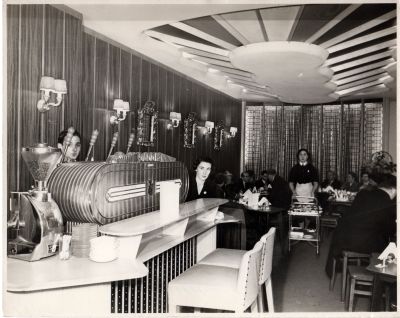
A typical café in the 1950s
During the same period, in 1957, series production of the America model began at Gaggia’s premises in Via Cadolini, Milan. With this machine, Gaggia further refined the efficiency of the lever system, achieving an even higher level of reliability and performance. Thousands of America machines would be produced. The model enjoyed considerable success and strengthened the company’s reputation in professional coffee equipment.
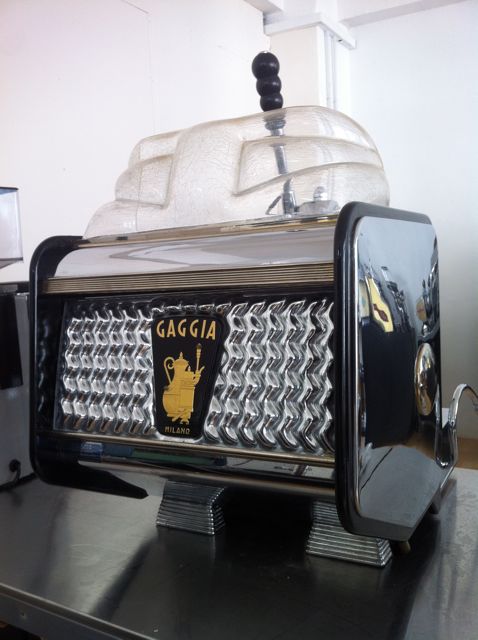
Gaggia Modello “America” 1957
In 1961, Giovanni Achille Gaggia, the distinguished founder of the brand and inventor of coffee crema, died prematurely. Management of the company passed to his son Camillo and his business partner Armando Migliorini, who inherited a company that had become a leader in the sector.
A timeline of Achille Gaggia’s developments. The invention and patent date back to 1938, but Achille, who, like Moriondo, had initially conceived the machine for his own café, was only able to develop his idea commercially in 1945, owing to the difficult circumstances of the Second World War. Manufacturing began in earnest in 1948.
1938. On 5 September, Achille filed patent no. 365726 for the Lampo system. This innovative mechanism used hot-water pressure instead of steam to produce an exceptional espresso topped with an intriguing layer of crema, then called “natural crema”. It was a revolution that marked the beginning of the modern era of Italian espresso.
1939. To promote the new brewing group and its natural crema, the Lampo system was presented at the Milan Trade Fair. Gaggia aimed to sell these groups to café owners as replacements for the groups on their existing machines. This proved difficult, however: the only solution was to manufacture new espresso machines equipped with the Lampo system.
1947. Gaggia registered his second patent, for a lever-operated brewing group. An intriguing story, perhaps a legend, suggests that the idea came to him while observing the pistons of an American jeep engine equipped with a particular hydraulic system. The new patent described a spring, compressed by a lever, driving a piston that forced hot water at high pressure through the ground coffee and filter, extracting its aromas. The barista could produce an espresso with rich crema and flavour in just 25–30 seconds: espresso as we know it today was born.
1948. Together with entrepreneur Carlo Ernesto Valente, Achille Gaggia founded “Officine Faema Brevetti Gaggia” and began producing his first espresso machine, the Tipo Classica. It was a technological and aesthetic revolution. The machine had a horizontal layout, striking levers, slogans and a distinctive logo; its shape allowed several groups to be positioned side by side. Working the levers to brew espresso, the barista seemed like a performer on stage. Gaggia’s lever machine was, in effect, the first true machine capable of producing espresso with crema as we know it today.
Leave a Reply