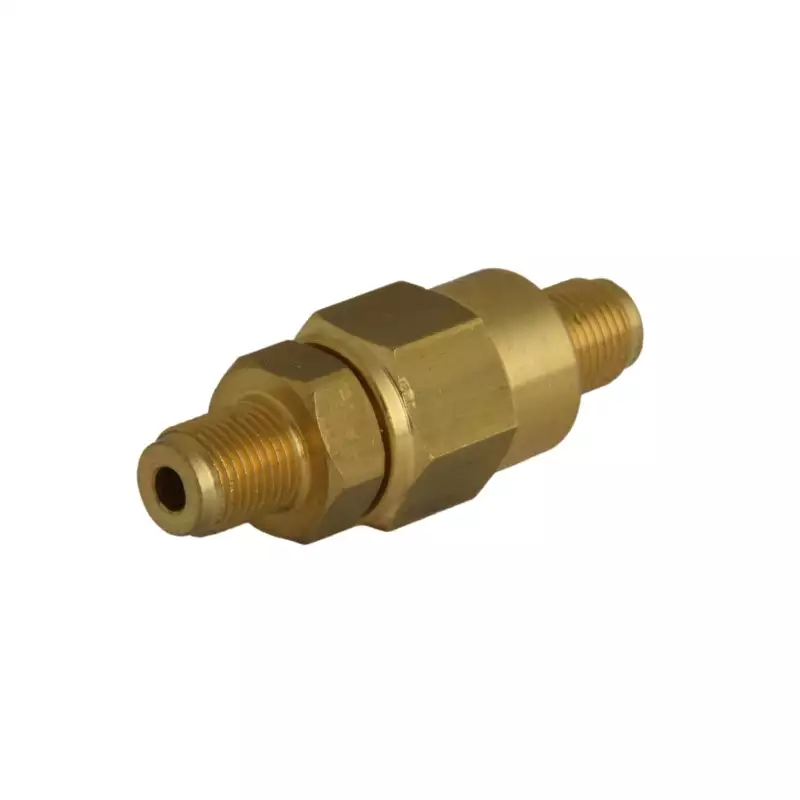
It lets water flow in one direction and stops it flowing back. A simple job that helps an espresso machine’s hydraulic circuit work as intended.
Level 1 — A small component with a specific job
When we talk about an espresso machine, attention usually turns to the pump, boiler and group head. But among the pipes and fittings are less visible components worth understanding. One of them is the non-return valve, also known as a check valve.
Its job is to let water travel in the intended direction and prevent it from flowing back.
To understand why it is needed, consider what happens between shots. The pump stops, while the water in the heat exchanger continues to absorb heat. As it warms up, it expands and, if confined, can cause pressure to rise.
When pressure in the heated part exceeds the pressure upstream, water tends to flow back towards the circuit it came from. This is when the valve needs to seal.
The component’s position depends on the machine’s design. Where it prevents backflow from the heat exchanger, it also helps keep hot water from reaching the pump and other upstream components.
While it works properly, it is easy to overlook. If it leaks or sticks, the machine may develop problems that initially seem to have a completely different cause.
Level 2 — What happens inside the valve
Opening and closing
A typical spring-loaded non-return valve contains a moving part, thepoppet, which rests against a seat and closes the passage. A spring holds it in place; sealing may rely on an elastomeric seal or another design.
When water arrives at the inlet with sufficient pressure, it pushes the poppet, overcomes the spring force and opens the passage.
As that force decreases, the spring helps the valve close. If water tries to flow back, pressure from the opposite side pushes the poppet against its seat and helps keep it closed.
The component therefore operates automatically, without an electrical command.
The pressure difference matters
Saying that the valve opens “when the pump starts” describes a common situation, but misses one detail: there is also pressure on the other side opposing its opening.
What matters is how much the inlet pressure exceeds the outlet pressure. This difference must be sufficient to overcome the spring force.
The pressure difference needed to start opening depends on the component. A figure such as 0.2–0.4 bar must therefore refer to a specific valve and be checked against its technical data sheet.
Circulation and backflow are different
In machines with a thermosyphon circuit, water can circulate between the heat exchanger and group head even between shots. This movement transfers heat and helps keep the group warm.
This circulation is part of the design. It is different from backflow towards the pump.
The non-return valve controls the branch in which it is installed: it prevents reverse flow at that point, rather than stopping every movement of water in the machine.
This distinction helps when reading a hydraulic diagram. Before describing water as “flowing back”, we need to understand which route it is taking and whether that movement is intended or abnormal.
Non-return and expansion: two different functions
When heated water expands and its route upstream is closed, any resulting pressure rise needs to be managed.
This is where the expansion valvecomes in, releasing some water when the specified pressure threshold is reached.
The non-return valve prevents reverse flow; the expansion valve limits pressure. The two functions may be combined in one body or provided by separate components.
Even when combined, they still perform different jobs. To identify the arrangement used, consult the machine’s hydraulic diagram: external appearance alone may not be enough.
Level 3 — When the valve is not working properly
There are two main faults: the valve lets water through when it should be closed, or restricts flow when it should open.
If it no longer seals
To seal properly, the poppet must make good contact with its seat. Wear, deposits or a particle trapped at the contact surface can compromise the seal.
The opening does not have to be large. Even a small gap can allow backflow when the pressure difference favours it. During brewing, however, everything may appear normal.
If the hydraulic layout allows it, hot water can reach the pump. The consequences depend on temperature, exposure time and the pumping system’s operating limits.
A leaking valve therefore deserves attention, without assuming that the pump has already been damaged.
If it sticks or becomes blocked
The opposite problem is a valve that does not open properly.
Internal passages can be small: deposits and particles may restrict the poppet’s movement or reduce the space available for water. The valve then becomes an obstruction even in the direction in which it should allow flow.
Possible signs include a slow start, reduced flow or uneven delivery.
A running pump does not guarantee that water can reach the group head. There may be a blockage along the way, and the non-return valve is one component to consider.
The same symptoms can also result from a filter, a metering jet or a solenoid valve. Finding the cause means following the circuit, rather than attributing every drop in flow to the pump.
Can the volume in the cup change?
In machines with volumetric dosing, the controller manages delivery using signals from a flowmeter.
A hydraulic fault can alter the relationship between the water measured and the water actually delivered by the group. The effect depends on the flowmeter’s position, the water path and the control logic.
A dose that differs from the programmed amount may therefore also call for a check of the non-return valve. On its own, however, it does not identify the valve as the cause.
The idea that backflow necessarily leaves the heat exchanger partly empty also needs care. Losing pressure and emptying are not the same thing: understanding what happens requires looking at the whole circuit.
What about preinfusion?
During preinfusion, water begins to wet the coffee puck before extraction at full pressure.
If a faulty valve changes the initial pressure or flow rate, this stage may be affected. Water may arrive at different times or in a different way from that intended.
Not all machines perform preinfusion in the same way. Some use mains pressure; others rely on mechanical chambers or electronic control.
The effect of a fault must therefore be assessed for the specific system. Steam is not required for effective preinfusion.
Start with the diagram
A machine may contain several non-return valves, installed in different places and performing different jobs.
Before blaming one of them for a problem, establish which section it controls, where the water comes from and what pressures act on its two sides. An arrow, where present on the body, shows the intended flow direction and must be respected during installation.
The internal valve must also be distinguished from backflow protection on the mains water connection. The presence of the first does not, by itself, determine how the machine should be connected to the water supply.
The hydraulic diagram and parts catalogue help put each component in context. They are the starting point for understanding why water flows, where it stops and which route it might take when something goes wrong.
Technical sources
Wega Mininova — Technician’s manual. Section 12.3, “Expansion – non-return valve”, printed page 14; hydraulic diagram, printed page 23. Read the PDF manual
Astoria/CMA CK, CKE, CKX and CKXE — Parts catalogue and hydraulic diagrams. Drawings IDCK-01 and IDCK-02 identify the non-return valve, part 20358, and the separate expansion valve. Copy hosted by Gastroparts. View the PDF catalogue
Il Caffè Espresso Italiano — “How a heat-exchanger espresso machine works, part two”. Further reading on thermosyphon circulation and the role of the valve upstream of the heat exchanger. Read the article
Seattle Coffee Gear — “Why Is There No Water Flow from My Group Head?” A troubleshooting article on blockages in the water circuit, including the non-return valve. Read the article
Circuit layouts and the effects of faults vary by model. The manufacturer’s manuals remain the reference for checking an individual machine.
Leave a Reply