
An espresso machine is often described through what we can see: coffee flowing from the group, steam coming from the wand and hot water pouring into a cup. Inside it, less visible components also play a crucial role when something goes wrong.
The steam boiler safety valve has a specific responsibility: to open a discharge path when pressure reaches its designated set point.
To understand this component, we start with its purpose and move on to the factors that determine its reliability.
Level 1 — What it does
Protecting the boiler
The steam boiler is a pressure vessel. Its operation requires devices that control normal working conditions and a protective device that can respond to overpressure.
The safety valve performs this protective role. When its set pressure is reached, it opens and releases steam, helping to limit the rise in boiler pressure.
Where it is fitted
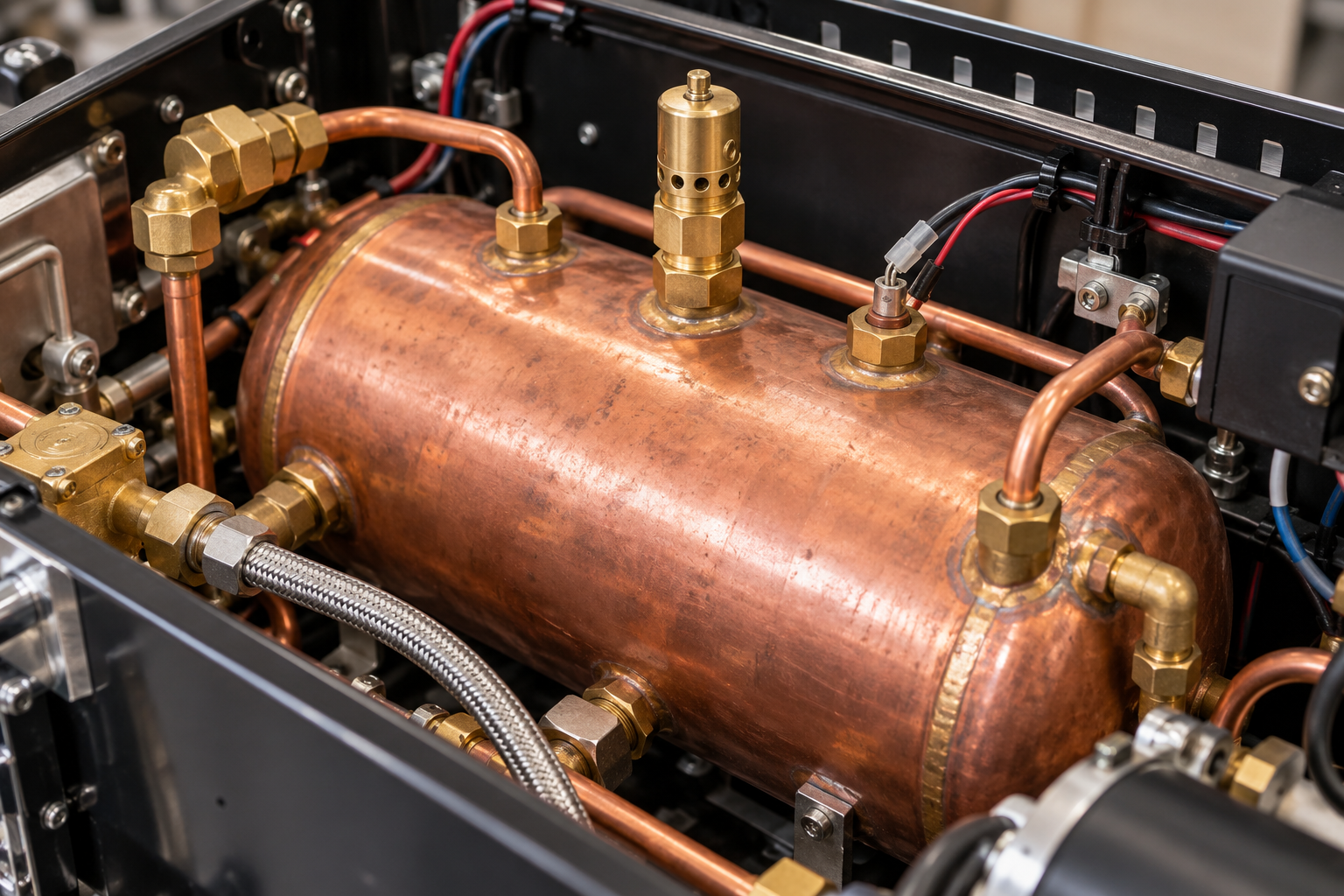
The safety valve is normally located at the top of the steam boiler, communicating with the space above the water level. Under normal conditions it is therefore exposed to steam rather than immersed in hot water. Its actual position and connection depend on the design of the machine.
This does not mean the valve is always dry: steam can condense. The inlet connection and any discharge pipework must be arranged to prevent condensate from accumulating in ways that could impair operation, in accordance with the manufacturer’s instructions.
How it is built
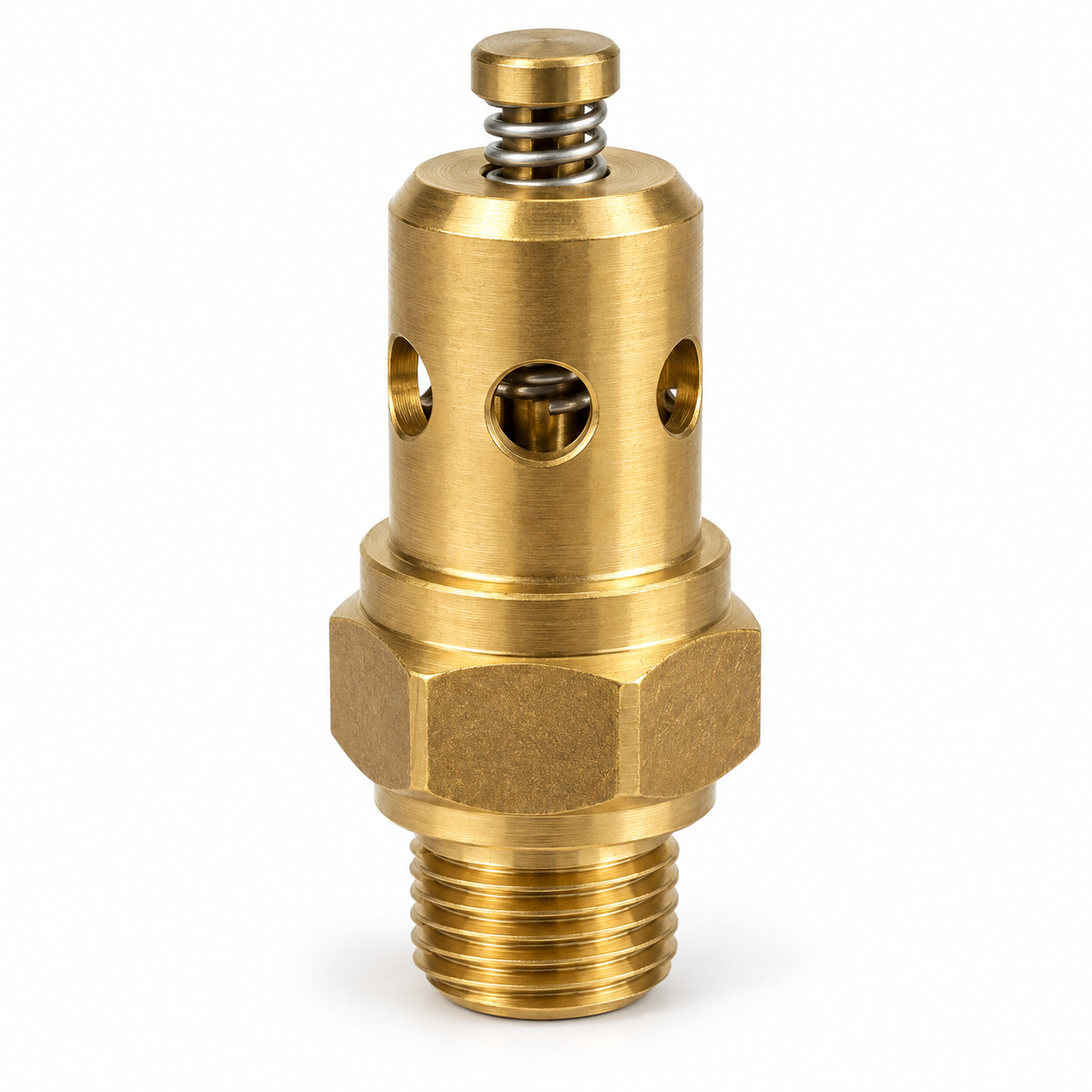
In a spring-loaded valve, two elements are fundamental: the disc with its sealing surface, and the spring that holds it closed.
Internal pressure exerts a force on the disc. The spring opposes that force and keeps the passage closed until the specified opening condition is reached.
When the force exerted by pressure exceeds the closing force, the disc lifts and allows discharge.
Distinguishing the different components
Several valves and control devices may be fitted inside the machine. Knowing their names is useful; understanding their roles makes the circuit easier to interpret.
| Component | Main function |
|---|---|
| Steam boiler safety valve | Protects the boiler against overpressure |
| Expansion valve | Limits overpressure in the hydraulic circuit supplying heat exchangers or dedicated coffee boilers |
| Anti-vacuum valve | Performs a separate function associated with vacuum conditions in the boiler |
| Pressure switch or control system | Controls the boiler under normal operating conditions |
This distinction also appears in some manufacturers’ documentation, where diagrams and parts catalogues identify these components separately.
Level 2 — How it operates
Sealing and opening must work together
During normal operation, the valve must keep the passage closed. When pressure reaches the designated set point, it must be able to open promptly.
The sealing element therefore has two responsibilities: preventing leakage and allowing the movement required for opening.
This combination makes long-term reliability important. A tight seal observed during normal use tells us only part of what the component must be able to do.
Opening, discharge and reseating
Operation involves three connected stages.
First comes opening at the specified pressure. Steam is then discharged from the boiler. Finally, once the specified reseating conditions are reached, the valve closes again.
To describe its operation, we therefore need to consider both opening and reseating pressures, together with discharge capacity.
How much it can discharge
Discharge capacity is the flow rate that the valve can release under specified conditions.
This information complements the set pressure. Opening pressure tells us when the component operates; flow rate tells us how much it can discharge while open.
Both contribute to protection. Capacity must suit the overpressure conditions considered in the design: a valve that opens at the correct pressure must also release enough steam. The component must therefore be selected according to the specifications for that machine.
The discharge path matters too
Protection also depends on the path followed by the steam after the valve opens. Obstructions or excessive backpressure in any discharge pipework can affect valve operation and reduce discharge capacity. Routing must follow the manufacturer’s specified configuration and provide safe discharge without condensate accumulation.
The set pressure depends on the machine
The set pressure must be appropriate for the machine and configuration for which the valve is specified.
Some manufacturers’ technical documentation lists valves set at 1.9 bar and others at 1.65 bar, for example, for different models or configurations.
These examples illustrate a key point: the correct set pressure must be found in the documentation for the particular model, version and installed component.
Level 3 — What reliability depends on
The seal and its materials
The sealing element may be made from elastomers, combinations of elastomers, or rigid materials incorporating fillers.
Its function requires properties that must be retained over time: sealing during normal operation and allowing opening when needed.
The sealing material is therefore part of the component’s design and must be considered alongside its other specified characteristics.
Four characteristics to consider together
| Characteristic | What it describes |
|---|---|
| Opening pressure | The pressure at which the valve operates |
| Reseating pressure | The pressure at which it closes again after discharge |
| Discharge capacity | The flow rate that can be discharged under specified conditions |
| Repeatability | The ability to maintain reliable behaviour over successive operations |
Together, these characteristics describe the component as a whole. Set pressure alone does not provide a complete assessment of its performance.
What can impair operation
Deposits and particles on the seat can prevent proper sealing. Corrosion, wear or deterioration of components can hinder movement or affect the seal. Incorrect installation can also impair operation.
A leak therefore requires technical assessment of its cause, including the actual boiler pressure. Blocking the discharge or changing the set pressure to stop a leak would compromise the protective function.
Follow the manufacturer’s maintenance instructions
Preventive maintenance also covers components that appear to work normally during everyday use.
Some manufacturers’ maintenance schedules specify annual replacement of the safety valve by qualified technical personnel.
This requirement applies to the models and document revisions that specify it. Each machine must follow its own maintenance programme, including any manufacturer updates.
Checking that the valve can operate
Looking for leaks is only part of the check.
Some manufacturers provide a dedicated technical function for testing the steam boiler safety valve, reserved for qualified personnel. This is an example of how the component’s actual ability to operate can also be checked.
Inspection, testing and replacement must therefore follow the instructions for the machine concerned. These are technical tasks requiring procedures appropriate to the model.
A component worth understanding even while it stays closed
The safety valve carries an important responsibility in a small space. It must seal, open under the specified conditions, provide adequate discharge and close again.
Its reliability comes from the combination of design, set pressure, discharge capacity and maintenance.
Understanding it means understanding a part of the espresso machine that remains outside the barista’s everyday routine, yet contributes to safe operation every working day.
Bibliography and technical documentation
La Marzocco, GS3 Operating Manual, MAN.2.1.01, version 1.3, September 2016: maintenance programme and safety valve replacement.
La Marzocco, KB90 Manual, MAN.22.1.01, version 2.1: technical programming and steam boiler safety valve test.
Simonelli Group — Victoria Arduino, Eagle Tempo Neo Digit, IT–EN–FR manual: hydraulic diagram and identification of devices.
Rancilio Group, Classe 7 E — Spare Parts Catalogue, C7E v.70, 4 December 2019: identification of the safety valve and anti-vacuum valve.
Rancilio Group North America, official spare parts portal, Epoca DE — Boiler Diagram: safety valve part number 10060532, listed at 1.65 bar.
Nuova General Instruments, Manuale uso manutenzione IT, 2020 edition: installation, identification and maintenance. https://www.nuovageneral.it/download.html?e=pdf&n=MANUALE_USO_MANUTENZIONE
Nuova General Instruments, Safety Valves Maintenance And Malfunction Reason: deposits, corrosion, wear and component selection. https://www.nuovageneral.it/learn-more-505/safety-valves-maintenance-and-malfunction-reason.html
Nuova General Instruments, Safety Valve Sizing: relationship between set pressure, fault conditions and discharge capacity. https://www.nuovageneral.it/learn-more-505/safety-valve-sizing.html
Spirax Sarco, Safety Valve Installation: condensate, cleanliness, connections and discharge backpressure. https://www.spiraxsarco.com/learn-about-steam/safety-valves/safety-valve-installation
Online documentation consulted on 1 and 2 November 2026. Model-specific data are examples referring to the relevant versions. Only applicable principles have been drawn from sources on industrial applications: sizing and maintenance intervals must be determined for the specific espresso machine.
Leave a Reply