A three-level journey that preserves the depth of the original text
LEVEL 1 - OVERVIEW
Before getting to the heart of the article, let us pause over the question from which everything begins: what really happens during the first few seconds after hot water meets the coffee puck?
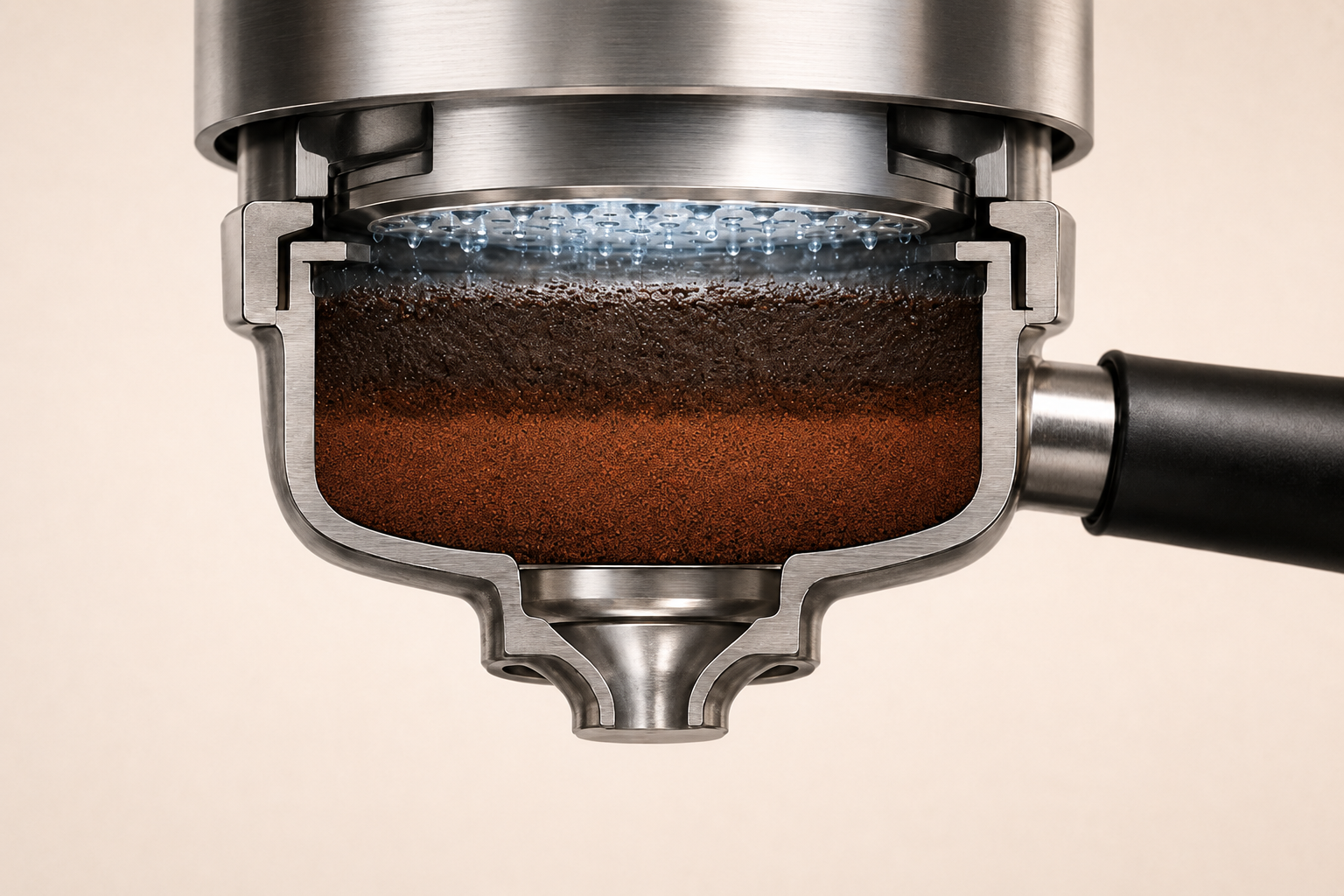
Pre-infusion is often described as a simple preliminary stage of extraction. In reality, a sequence of phenomena unfolds within those few seconds: water penetrates the ground coffee, trapped air is displaced, the particles hydrate and swell, carbon dioxide is released, and the resistance offered by the puck to the flow of liquid changes progressively.
This is where the central question of the article arises: why can the way water reaches the coffee influence everything that happens afterwards? And why do distribution, tamping, the porosity and permeability of the grounds, together with temperature and the progression of pressure across the coffee puck, become parts of the same phenomenon? The answer lies in the fluid dynamics of the process, in which these variables determine the geometry and resistance of the surface. Temperature and pressure become part of this system, merging into a single physical phenomenon that defines hydraulic resistance and the final transfer of substances into the cup.
The next level preserves the author's reasoning in full: it is not an abridged version, but the scientific path through which the different phenomena of pre-infusion and infusion are connected.
Key idea: pre-infusion is not a waiting period before extraction. It is the moment in which the physical conditions that will determine how water travels through the puck are established.
LEVEL 2 - IN-DEPTH EXPLANATION
The author's text, with its depth and logical development preserved.
The mystery and debate surrounding pre-infusion
Among coffee-extraction enthusiasts, as well as among those who deal with it professionally or for other reasons, pre-infusion is one of the most widely discussed subjects. It evokes an aura of esoteric mystery, an enigmatic and secret veil suspended between legend and alchemical narrative, almost as though it were occult knowledge.
Interpretations, doubts and real usefulness
The intrinsic meaning of the term and its actual benefit for the final espresso in the cup are often debated. The interpretations, meanings and physicochemical phenomena attributed to pre-infusion are numerous and sometimes decidedly contradictory; in other cases, there is only a vague idea of what it is and whether it is genuinely useful.
Its indispensable role in Italian Espresso
The answer to that last question can be anticipated immediately: absolutely yes. Pre-infusion is not only useful; it is indispensable if the aim is to produce a high-quality Italian Espresso.
The term describes a specific stage of brewing - certainly the most important one - that takes place during the first moments of the process.
The scientific approach and thought experiments
Let us explain pre-infusion on the basis of experiments and comparisons with sensory-analysis experts, but above all through thought experiments that make it possible to visualise the concept in an abstract way.
What pre-infusion is
Definition of pre-infusion. The prefix 'pre' indicates an earlier moment, when something occurs before something else. In reality, however, pre-infusion and infusion are very closely related processes, almost the same thing or, at least, processes that merge seamlessly. Rhetorically, we could say that pre-infusion is the phenomenon through which coffee infusion is discretised. This interaction between the two stages, one merging into the other, characterises the very first moments of brewing and lasts, on average, between 2 and 6 seconds.
The physicochemical nature of the process
To define the difference between pre-infusion and infusion more precisely, we could say that pre-infusion is a physicochemical process: it describes the way hot water reaches the coffee puck, but also the time during which that same water permeates, hydrates and infuses it.
At this stage, water is not yet acting as a transport medium that carries soluble substances into the cup, but as a preparatory element.
Fluid dynamics and interaction with coffee
From the perspective of fluid dynamics, the water flow meets the coffee puck, also known as the coffee bed, at almost zero pressure, or in any case at a pressure far below the conventional 8-9 bar used for extraction. By capillary action, water penetrates the spaces between the particles, displacing trapped air and uniformly wetting the coffee's cellulose structure.
Hydration, degassing and compaction
This initial contact triggers an extraordinary physicochemical phenomenon: hydration and the resulting swelling of the particles, accompanied by the immediate release of carbon dioxide, known as degassing. This 'breathing' of the coffee causes the puck to compact naturally, sealing microchannels and preferential escape paths that water would inevitably seek if subjected to sudden, violent pressure.
Pressure management and final extraction
Pre-infusion therefore acts as a pressure moderator: it 'tames' the machine's hydraulic force, compelling the coffee puck to become a homogeneous and coherent barrier. Only when every single milligram of grounds has been fully impregnated does hydraulic resistance rise naturally and uniformly, preparing the way for the actual infusion. From that precise moment, pressure increases progressively to its maximum level, initiating a balanced extraction rich in lipids, oils, carbohydrates and simple sugars, without localised over-extraction.
The importance of distribution and tamping
To achieve effective pre-infusion, in addition to the obvious characteristics of particle size and ground-coffee volume - which remain fundamental - the levelling of the coffee in the filter and the force used to compress it are equally important.
Channeling and extraction defects
This latter precaution is particularly important because the coffee puck must not contain areas with different specific resistance to water flow. Otherwise, during brewing, uneven points of flow resistance will develop across the various portions of ground coffee. This phenomenon will certainly compromise extraction quality. Water flows faster where it encounters less resistance; conversely, its passage through more compacted areas will be reduced or even absent. The resulting effects on the coffee will be under-extraction and over-extraction, respectively.
Insufficient attention by espresso operators to levelling and to the uniformity of the pressure applied to the puck is one of the most frequent causes of a very poor result in the cup.
Physical characteristics and the hygroscopic nature of coffee
Coffee consists of numerous plant components that, after roasting, form a highly porous structure. The grounds are so absorbent that they take on the odours of substances with which they come into contact or near which they are stored. They are also particularly hygroscopic and therefore susceptible to both increases and decreases in ambient relative humidity. This characteristic of ground coffee strongly influences the ease with which water can pass through it during brewing.
The thermohydraulic reaction of the first layer
All these variables come into play during pre-infusion, and not only then. The first layer of coffee, closest to the dispersion screen, is the first to be reached by hot water and remains involved throughout the brewing process. Porous and permeable materials such as coffee tend to swell when moistened, increasing their resistance to the passage of water.
The progression of flow through the lower layers
The lower layers of coffee - and they must be considered as innumerable - are reached not only by water, but also by the brew coming from the first layers. This brew performs a surfactant function, increasing the ability to dissolve and emulsify components in the other layers of ground coffee.
Absorption capacity and influencing variables
Experimental evidence indicates that the average water-absorption capacity of ground coffee ranges from 1 to 1.2 ml per gram. This value depends on the permeability and porosity of the grounds, factors directly influenced by grind size and the pressure applied to the puck, as well as by the coffee variety used (Robusta absorbs more water than Arabica), water temperature, and the type or time/volume of pre-infusion - the latter being of fundamental importance.
Layer-saturation dynamics
Once the first layer is saturated, water and brew proceed towards the subsequent layers.
The brew produced up to this point becomes a concentrated solution that contributes to the solvation of the layers below.
The difference between pre-infusion and infusion
In other words, the main difference lies in the timing and pressure with which water wets the coffee: pre-infusion is the preliminary low-pressure stage that wets the bed of grounds, whereas infusion, or extraction, is the principal high-pressure stage that causes the beverage to flow into the cup.
L’infuso di caffè espresso diventa a tutti gli effetti un liquido con proprietà tensioattive.
During high-pressure extraction, water does more than dissolve soluble substances: it also extracts natural chemical compounds that act as true surfactants.
Pressure management and progression
Throughout this pre-infusion stage, the water - often accompanied by steam microparticles - that comes into contact with the coffee must initially be at very low pressure, between 1 and 3 atmospheres, with an upward gradient. Only during the final moments of the process should the pressure approach the actual brewing pressure.
LEVEL 3 - TECHNICAL READING
This level does not rewrite the article. It isolates the parameters and technical steps already present in the text, allowing the reader to review them as a map of the phenomenon.
Duration of the initial stage: Pre-infusion occurs during the very first moments of brewing, with an average duration stated in the text of between 2 and 6 seconds.
Initial pressure: Water comes into contact with the puck at very low pressure. In the final part of the article, an initial range of 1-3 atmospheres is indicated, with an increasing gradient.
Brewing pressure: The text refers to the conventional 8-9 bar as the reference pressure for the extraction stage.
Pressure gradient: The transition from pre-infusion to brewing must not be immediate, but should develop through a progressive ramp. This optimal transition between the two pressure levels should take place over a period of 1-3 seconds.
Capillary action: Water penetrates the spaces between the coffee particles by capillary action, displaces trapped air and progressively wets the structure of the grounds.
Hydration and degassing: Contact with water causes hydration, swelling of the particles and the release of carbon dioxide.
Hydraulic resistance: As the puck becomes impregnated, resistance to water flow increases; the homogeneity of the bed therefore becomes decisive.
Channeling: Local differences in resistance cause water to flow faster through less compacted areas and more slowly through areas offering greater resistance, creating a risk of under- and over-extraction.
Absorption: The text reports an average absorption capacity of 1-1.2 ml of water per gram of coffee.
Variables affecting absorption: Permeability, porosity, grind size, pressure on the puck, botanical variety, water temperature, and the type, time and volume of pre-infusion.
Arabica and Robusta: The text specifies that Robusta absorbs more water than Arabica.
Layer-by-layer progression: Once the first layer is saturated, water and brew proceed towards the subsequent layers.
Surfactant properties: The brew coming from the upper layers is described as a concentrated solution with a surfactant function, capable of contributing to solvation and emulsification in the lower layers.
Pre-infusion vs infusion: The former is the preliminary low-pressure stage that wets and prepares the puck; the latter is the principal high-pressure stage that carries the beverage into the cup.
Sequence of the phenomenon
- Water arrives at low pressure.
- It penetrates the spaces and displaces trapped air.
- The particles hydrate and swell.
- CO2 is released through degassing.
- The hydraulic resistance of the puck changes progressively.
- The first layers become saturated, and water and brew advance.
- Pressure rises gradually towards the extraction stage.
Editorial note. Level 1 is an editorial gateway. Level 2 preserves the author's original text without reducing its conceptual development. Level 3 organises only concepts and values already present in the original, without introducing external scientific content.
Leave a Reply