
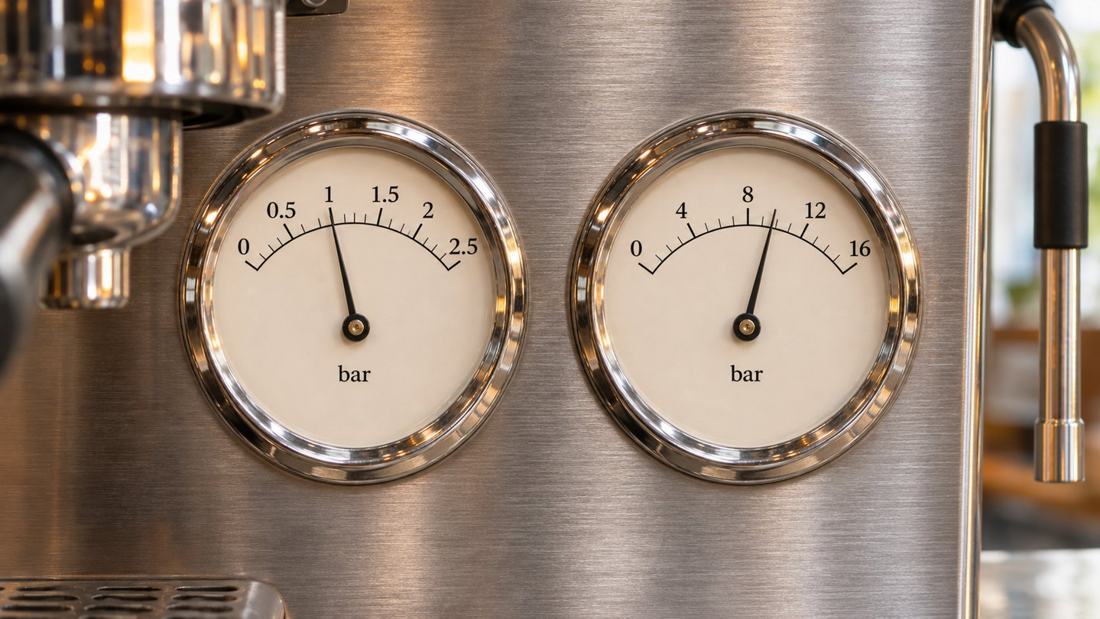
The Espresso Machine Pressure Gauge
Two pressures on the same front panel
In Boiler Physics, we looked at how pressure builds when water is heated in a sealed vessel. Now let’s look at the machine from the outside. As it heats up, one needle rises. When we start pulling an espresso, the other moves. What are they measuring?
Level 1 · Reading the two needles
Many commercial espresso machines display two pressure readings, either on two separate gauges or on a single dial with two scales.
| Gauge | What it measures | When to watch it |
|---|---|---|
| Steam boiler | The pressure in the boiler that supplies the steam wand | While the machine heats up and while steaming milk |
| Pump circuit | The pressure at the point where the gauge connects to the water circuit | While pulling an espresso |
When the machine is cold, the steam boiler needle usually starts near zero. It rises as the machine heats up and may drop when you draw steam. When you pull an espresso, watch the pump circuit gauge.
Level 2 · What does the reading mean?
One bar on the boiler gauge
On a gauge that measures relative pressure, zero corresponds to atmospheric pressure. If the needle reads 1 bar, the pressure inside the boiler is about 2 bar absolute. Absolute pressure is the value you use in saturated steam tables to relate pressure to temperature.
Where is espresso pressure measured?
The needle shows the pressure at the point where the gauge is connected. During extraction, water flows from the pump to the group head and through the coffee puck. Two gauges connected at different points can therefore show different readings during the same shot.
Depending on the machine, pressure may be measured in the pump circuit or closer to the coffee puck. If water runs freely through the group, the pressure measured there can be lower because there’s no coffee puck to restrict the flow. To compare two readings, check where they were taken and what the machine was doing at the time.
Level 3 · Inside the pressure gauge
Two connections, two readings
On this type of dual-scale gauge, there are two independent connections behind the dial. One connects to the steam boiler and the other to the pump circuit. Each needle has its own scale.
One real-world example is a 60 mm gauge with full-scale values of 2.5 and 16 bar. The table shows how those scales can be matched to the two circuits.
| Circuit | Example operating pressure | Gauge scale |
|---|---|---|
| Steam boiler | About 1 bar | 0–2.5 bar |
| Pump circuit | About 8–9 bar | 0–16 bar |
The full-scale value is the highest value marked on each scale. When selecting a gauge, also consider the highest pressure expected, pressure pulsations, temperature and the operating limits in the data sheet.
From the Bourdon tube to the needle
The 60 mm model uses a copper-alloy Bourdon tube. This small, curved metal tube tends to straighten slightly as pressure inside it increases. A linkage and a toothed sector transfer that movement to the needle.
Pressure pulsations in the pump circuit can make the needle oscillate. A damped movement, available as an option on this model, reduces those oscillations and makes the gauge easier to read.
How accurate is the reading?
The data sheet specifies an accuracy of 1.6% of full scale and lists EN 837-1 as the reference standard. Under reference conditions, this corresponds to a permissible deviation of approximately ±0.04 bar on the 2.5 bar scale and ±0.26 bar on the 16 bar scale. The calculation uses the full-scale value even when the needle reads, for example, 9 bar.
Next time you’re at an espresso machine, watch the needles as it heats up, while you draw steam and while you pull a shot. To interpret each reading, ask yourself which circuit you’re looking at and where the pressure is being measured.
Sources
- Orman S.r.l., MDS60 Ø 60 Dual-Scale Gauge, data sheet for the MDS60RI model.
- Pressure Gauges for Espresso Machines, technical reference for dual-scale configurations and example operating pressures.
- Nuova Simonelli, Appia Life 1 Group User Manual.
- La Marzocco, Strada EP User Manual.
- WIKA, pressure gauge guide and model 111.10 specifications.
Leave a Reply