The small component that protects the hydraulic circuit of an espresso machine
Article developed across three reading levels
OVERVIEW → IN-DEPTH → TECHNICAL
LEVEL 1 · OVERVIEW
A relief path for pressurised water
Inside an espresso machine, water does not always remain at the same pressure: the pump pushes it through the hydraulic circuit of the heat exchangers, valves control its path, and heating causes it to expand. Under certain conditions, pressure can therefore rise even when no coffee is being brewed.
The expansion valve acts as a controlled pressure relief for the pressure generated in the heat-exchanger manifold. When this pressure exceeds the preset limit, the valve opens automatically to allow fluid to escape, preventing damage to the circuit.
In a hydraulic circuit, fluid pressure can increase because of heating or changes in the volume of the system. The expansion valve is designed to keep this pressure within safe limits. The valve is generally equipped with a spring- or diaphragm-based mechanism that keeps the passage closed as long as the pressure remains below the preset value.
In short, the expansion valve automatically controls the internal pressure of the hydraulic circuit, opening a relief path only when necessary and closing again as soon as conditions return to normal, helping to ensure the safety and efficiency of the system.
The principle is simple: the valve remains closed during normal operation and opens only above a threshold. Its presence helps protect pipes, fittings and other components from overpressure in the hydraulic circuit.
IN SHORT
The expansion valve does not generate extraction pressure. It operates when the pressure in the section it controls exceeds the threshold specified by the manufacturer.
Where it is located
Its position depends on the architecture of the machine. In the reference circulation-group diagram, the valve must be located immediately after the non-return valve. The latter prevents water from flowing backwards; for this very reason, water trapped downstream of the non-return valve may need a relief path when it heats up and expands.
What the user may notice
A small discharge of water is completely normal and, in fact, necessary, especially during heating and also after a coffee extraction. Continuous discharge, however, indicates a valve malfunction, which may be caused by dirt on the seat, limescale, a worn seal, a weakened spring or incorrect adjustment. A complete absence of discharge, under conditions in which the valve should operate, may also indicate a malfunction and a potential risk of overpressure. In these cases, intervention by a qualified technician is required.
Continue to Level 2 · In-depth →
LEVEL 2 · IN-DEPTH
Why pressure can rise even when the pump is stopped
Pressure can increase even when the pump is stopped because water, like many fluids, expands when heated. In an open circuit this change in volume is absorbed without difficulty; in a closed section, however — isolated by non-return valves or other shut-off devices — thermal expansion results in a significant increase in pressure.
The expansion valve is designed to limit this increase. It does not maintain constant pressure; rather, it acts as a mechanical threshold device. As long as the force exerted by the water on the valve obturator remains lower than the spring preload, the valve stays closed. When the pressure exceeds that threshold, the valve opens and allows water to discharge; once the pressure falls below the set value again, the valve closes.
Description of the hydraulic circuit
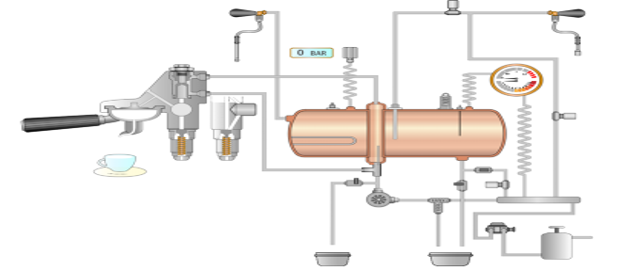
- The pump supplies the hydraulic circuit.
- The non-return valve allows flow in one direction only and prevents water from flowing backwards.
- The water downstream of the non-return valve is heated and expands.
- If the pressure exceeds the expansion valve setting, a discharge path opens.
- When the pressure decreases, the spring returns the obturator to its seat.
Do not confuse it with other valves
| Component | Main function | When it operates |
|---|---|---|
| Expansion valve | Limits overpressure in the water circuit and provides controlled discharge. | Above the set threshold for the protected section. |
| Pump bypass | Regulates or limits the pressure generated by the pump, often by recirculating part of the flow. | When the pump is running and the pressure reaches the set value. |
| Safety valve | Protects a vessel or boiler against dangerous pressure conditions. | At a safety threshold defined by the design and applicable regulations. |
| Non-return valve | Prevents water from flowing backwards. | Whenever the fluid attempts to move in the opposite direction. |
Signs of abnormal operation
- Dripping and/or continuous discharge from the valve even after the temperature has stabilised.
- Premature opening of the valve, with water loss and difficulty reaching the expected pressure.
- Failure of the valve to open, with pressure spikes in the hydraulic circuit.
- Irregular operation after periods when the machine has been idle or when very hard water is used.
- Limescale deposits in the discharge line or water leakage near the discharge point.
These symptoms alone do not allow a definitive diagnosis. A leak may also depend on mains water pressure, the pump bypass, the non-return valve or other elements of the circuit. Diagnosis should therefore start from the machine’s hydraulic diagram and from a correct pressure measurement.
Continue to Level 3 · Technical →
LEVEL 3 · TECHNICAL
Balance between hydraulic force and spring preload
Sequence of the phenomenon: step by step
- Water heating. Il generatore di calore (caldaia – scambiatore) aumenta la temperatura dell’acqua presente nel circuito idraulico.
- Thermal expansion. As the water heats up, its volume increases slightly. In an open circuit this expansion is absorbed; in a closed circuit, however, there is no space available for it.
- Section isolated by valves. If non-return valves or shut-off devices are present in the circuit, some sections may become closed volumes that cannot compensate for expansion.
- Conversion of expansion into pressure. Since the volume cannot increase, the expansion of the water is converted into an increase in internal pressure. Even a small change in volume can generate an increase of several bar.
- Pump stopped → limited heat distribution. With the pump stopped, heat is not distributed through the circuit: hot zones expand locally, amplifying the pressure increase in the isolated section.
- Expansion valve operation. The valve remains closed until the pressure overcomes the spring preload.
- Below threshold → valve closed
- Above threshold → the valve opens and discharges
- Pressure reduced → the valve closes again
- Temporary stabilisation. After discharge, the pressure drops, but if heating continues and the section remains closed, the cycle repeats.
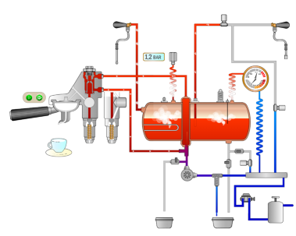
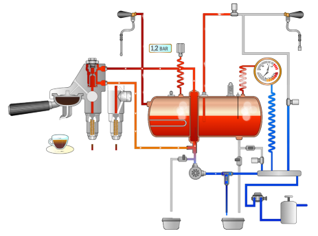
The expansion valve begins to open when the force exerted by the water on the obturator exceeds the spring force and the small friction forces within the mechanism. The force with which the water acts on the obturator depends on the pressure and on the surface area over which that pressure acts.
In simplified form, the relationship is: F = P × S
For the same surface area, an increase in pressure produces a proportional increase in the force tending to open the valve. When this force becomes greater than the resistance of the spring, the obturator lifts and the valve begins to open.
The adjustment screw acts on the spring preload. Tightening it increases the force exerted by the spring on the obturator and, consequently, the pressure required to open the valve. Loosening it reduces the preload and the valve begins to open at a lower pressure.
It is nevertheless essential to check the direction of adjustment and the correct procedure for the specific component: not all valves are built in the same way and they may differ in adjustment range, internal geometry and adjustment-screw locking systems.
WARNING
Adjustment must not be carried out “by feel”. A hydraulic diagram, a reliable pressure gauge, defined test conditions and the manufacturer’s instructions are required. Before any intervention, the machine must be made safe by qualified personnel.
Static pressure, dynamic pressure and measurement point
Pressure is meaningful only if it is clear where it is measured and under what conditions. Pressure measured with the pump stopped and the circuit hot does not describe the same phenomenon as pressure measured during extraction. Likewise, the pump or group pressure gauge may not accurately represent the pressure in the section protected by the expansion valve.
For this reason, it is not correct to automatically attribute regulation of the approximately 9 bar commonly associated with extraction to the expansion valve. In many machines, that value is determined mainly by the pump bypass or by the pressure-control system, while the expansion valve performs a separate function and is not directly involved in regulating extraction pressure.
It is important to remember that different architectures exist: the configuration chosen by the manufacturer — and therefore the machine’s hydraulic diagram — always remains the reference for determining which component governs pressure during each phase of the cycle.
What does it really change in the cup?
The expansion valve does not directly produce aroma, body or crema. Its effect is indirect: it helps keep the circuit operating under more stable and predictable conditions. If the valve opens too early or leaks significantly, it can alter the available pressure and the amount of water reaching the group. If, on the other hand, it fails to open when it should, the circuit may be subjected to unintended and potentially dangerous stresses, with possible consequences for extraction consistency.
Espresso quality depends on the interaction of several elements: pump, valves, temperature, flow rate, brewing group and the resistance of the coffee puck to the passage of water. The expansion valve is therefore a small component with an important function, but it should not be considered the sole or primary cause of every extraction problem.
Conclusion
The expansion valve operates almost always out of the barista’s sight: it opens briefly, discharges a small amount of water and immediately closes again. This discreet operation can make it seem like a minor component, but in circuits designed to include one it is a fundamental element for controlling overpressure.
Understanding its role means looking at the espresso machine as an integrated system: the pump sets the water in motion, the non-return valve determines its direction, heat changes its volume, and the expansion valve provides a relief path when pressure exceeds the set limit. Reliable and repeatable operation comes from the balance between these elements — an essential condition for consistent results in the cup.
Leave a Reply